This is part 3 of my Actual Good News series of articles on the topic of biblical soteriology (the study of salvation). Part 2 is available here: What the Hinnom?
Please note that I’m including many of my scriptural references in the links (which are are the underlined words throughout the article), and they also link to studies with extended details that I couldn’t fit into the article, so please be sure to click all the supporting links in order to get the full picture, as well as all the Scripture references.
Anyone who believes in never-ending punishment (be it Infernalism or Annihilationism) will, of course, refer us to the various passages in the Bible which use words such as “for ever,” “everlasting,” and “eternal” in order to defend the popular doctrine. And yet, anyone who has read the whole Bible and actually paid attention while doing so should also be well aware of the fact that these words, when used in the less literal English Bible versions such as the KJV (the King James Version) which translate the original Hebrew and Koine Greek Scriptures this way, rarely actually mean “never-ending” or “without end” the way most people assume they do. However, for those who somehow missed this fact while reading their Bibles, I’m going to demonstrate it in this chapter. I say “less literal” because truly literal Bible translations such as the YLT (meaning Young’s Literal Version) and the CLV (meaning the Concordant Literal Version) often render these words closer to the way they were actually meant to be understood in Scripture, meaning as referring to a specific period of time with a definite beginning and end, even if the end date is unknown. However, I’m not claiming that the KJV and other less literal Bible versions were mistranslated here, because one can still get the truth from the less literal versions of the Bible by simply realizing that these English words in these translations were generally intended to be interpreted figuratively rather than literally (or qualitatively rather than quantitatively). This isn’t to say it’s impossible that these words are sometimes meant to be interpreted quantitatively rather than qualitatively in certain passages where they’re used in the KJV and other less literal Bible translations, of course (and I’m certainly not insisting that they couldn’t possibly have ever had a quantitative meaning when they were used outside of Scripture back then either), but one has to consider each instance of these words extremely carefully when reading Scripture, looking at the context of the passage, as well as of Scripture as a whole, before deciding they are meant to be interpreted quantitatively in a specific passage, so as not to contradict the rest of Scripture (since, if Scripture actually contradicted itself in any way at all, there would be no reason to even consider what the Bible has to say about this — or any other — topic in the first place, and nearly anyone who did so would likely be wasting their time).
For example, in Exodus 21:6 we read about servants who choose to remain in servitude rather than going free on the seventh year, as was their right: “Then his master shall bring him unto the judges; he shall also bring him to the door, or unto the door post; and his master shall bore his ear through with an aul; and he shall serve him for ever.” If we interpret “for ever” as literally referring to a period of time that never ends, it would either mean that the servant (or slave) in question can never die, or that the servant will have to remain in bondage to his master without end, even after both of their physical resurrections and judgements at the Great White Throne in the distant future (as well as in any afterlife in the meantime, at least if one actually exists, even if they both ended up in different places while dead). Since I doubt anyone believes either of these options to be the case, I trust everyone would agree that the “for ever” in this verse is actually a hyperbolic translation which really means “for a specific time period, even if the end date (the time of the servant’s death) is currently unknown,” which demonstrates that when we see the phrase “for ever” in the Bible, we can’t just automatically assume it means “without end.”
Of course, those who use other Bible versions might point out that they say things like “for life,” or “permanently,” rather than “for ever” in this verse, but at the very least, we all have to admit that עוֹלָם/“o-lawm’” (which is the Hebrew word that “for ever” is translated from in this verse in the KJV) doesn’t literally mean “without end” or “never-ending” (or at least doesn’t necessarily always mean “without end” or “never-ending”), and this tells us that just because we see “for ever” in an English translation of the Hebrew Scriptures (or even the English word “everlasting,” for that matter, which is also often translated from the same Hebrew word), it doesn’t mean that we should just automatically assume it means “without end” or “never-ending” either, which is really all I’m getting at here.
However, I have had people insist that, even if the word עוֹלָם doesn’t necessarily mean “never-ending” in an ontological sense, the word should still always be understood as meaning something along the lines of: “it’s going to be like this for as long as the thing or person in question exists.” Well, even if that were true, this assertion doesn’t help prove the idea of Infernalism at all anyway, since immortality for humans is always connected with salvation in Scripture, as I pointed out in the last article, so any human who actually remains alive permanently can’t be cast into the lake of fire — which is a physical location on a physical planet, and not a place in an “afterlife realm,” as we learned in the last article — because if they’re immortal it means they’ve already been saved, and those who are saved don’t end up in the lake of fire (which means that Infernalism is already out of the question right off the bat, leaving only Annihilationism and Universalism as potential options, but we’ll get more into all of those details a little later in this series of articles too).
But is there any basis for my assertion that the word עוֹלָם doesn’t necessarily mean “without end” anywhere else in the Bible, or are those the only examples? In fact, that this word doesn’t necessarily mean “never-ending” when it’s used in the Bible can be seen in many places throughout the Hebrew Scriptures (meaning the books of the Bible that are generally referred to as “the Old Testament”). For example, Isaiah 32:14–15 says: “Because the palaces shall be forsaken; the multitude of the city shall be left; the forts and towers shall be for dens for ever, a joy of wild asses, a pasture of flocks; Until the spirit be poured upon us from on high, and the wilderness be a fruitful field, and the fruitful field be counted for a forest.” Unless we’re meant to believe that Jerusalem will be left forsaken and desolate and never recover or be inhabited again, as verse 14 seems to say, we have to interpret that “for ever” as meaning a specific period of time again, just as we had to do with the previous example. And, indeed, verse 15 tells us when that “for ever” ends, stating that Jerusalem will be left deserted “for ever,” until the spirit be poured from on high (which proves that עוֹלָם isn’t required to mean “it’s going to be like this for as long as the thing or person in question exists,” since otherwise Jerusalem would have to remain forsaken permanently rather than eventually be restored).
And those weren’t the only passages to demonstrate that it doesn’t mean “never-ending” either. We also read about the fact that the Levitical priesthood will be “everlasting” in Exodus 40:15 (with “everlasting” also being translated from עוֹלָם there), yet we know from Hebrews 7:14–22 that the priesthood of Aaron’s descendants is to be replaced by Jesus Christ, who will be “a priest for ever after the order of Melchisedec,” and we know from 1 Corinthians 15 that even this new priesthood which is figuratively said to last “for ever” is eventually no longer going to be necessary either (since you don’t need any priests once there’s no sin or death remaining). That this “everlasting” priesthood will eventually come to an end is also backed up by the fact that, while the believing descendants of Isaac and Jacob will reign over the people of the earth as “kings and priests” during the thousand-year period of time when the kingdom of heaven finally fully exists on earth, there almost certainly won’t be any Israelite priests on the New Earth at all, because there won’t be any need for them with no physical temple in the New Jerusalem.
Similarly, in Isaiah 24:5 we read: “The earth also is defiled under the inhabitants thereof; because they have transgressed the laws, changed the ordinance, broken the everlasting covenant.” This seems to tell us that the Old Covenant (also known as the Mosaic Covenant) can never come to an end and be replaced by a New Covenant because it’s said to be “everlasting,” but we know from other parts of Scripture that there will be a New Covenant for those in the house of Israel and the house of Judah, and that their Old Covenant in fact began to decay when Christ died (and will indeed eventually vanish away entirely, if it hasn’t already). So we can see that “everlasting” doesn’t necessarily mean “never-ending” or “without end” when we read that word in the Bible any more than “for ever” does.
And it’s not just the Old Covenant that’s referred to as an “everlasting covenant” in the KJV. The Abrahamic covenant is too, in 1 Chronicles 16:16-18. ut since we know that the specific portion of land called Canaan (now known as the land of Israel), which is what the promise in this covenant is about, will eventually cease to exist when the planet that land is located on is replaced by the New Earth, the “everlasting” period of time that this covenant consists of will also expire when our current earth does (which has to happen either way, since if our current universe isn’t replaced by a New Heaven and a New Earth, our current earth would get pretty dark at the time of the heat death of the universe, presuming it isn’t first engulfed by the sun when our star goes Red Giant, of course, as is believed to be likely to happen in a few billion years, give or take, so either way, the land promised in this “everlasting” covenant is going to cease to exist eventually, and thus the covenant must also).
The translators of the KJV also demonstrated quite clearly that they didn’t believe עוֹלָם always means “without end” in Ecclesiastes 12:5, where they used the word עוֹלָם to say “his long home” when referring to the time someone who is dead spends in the grave. Since we know that everyone who dies will eventually be resurrected to face judgement (or enjoy salvation) one day, nobody could ever be resurrected from the dead if עוֹלָם meant ”never-ending.” (Interestingly, though, some Bible versions actually do translate the verse to say “eternal home,” confirming that the word “eternal” is meant to be read just as figuratively in those versions as it is in the KJV, unless we’re to believe there’s no resurrection of the dead.)
Now, I could go on and on with example after example of things that were said to be “for ever” or “everlasting” that eventually ended (or that are said will eventually end) in the Bible, but I trust it’s obvious by now that nearly all of the passages that are translated from the Hebrew Scriptures as saying “eternal,” “everlasting,” and “for ever” in the popular, and less literal, versions of the Bible have to be interpreted qualitatively and figuratively rather than quantitatively and literally (just as these English words are almost always still used by us today: as hyperbole, meaning they’re exaggerated expressions used for the sake of emphasis; for example, if I were to say, “This church service is going to last for ever because the preacher never stops talking,” I doubt you’d assume that the meeting will actually last for all eternity and that the speaker will continue preaching for all that time as well, although, if you aren’t sure about this, please ponder it for the amount of time it takes an Everlasting Gobstopper to dissolve in your mouth, perhaps while watching a video of one of the various “eternal flames” people have lit being extinguished — the jawbreaker candy might take “for ever” to be completely consumed, perhaps even longer than that video lasts, but like most things which are said to be “everlasting” or “eternal,” its time will eventually come to an end as well). Simply put, it seems the translators believed that those who read the KJV (or who heard it read aloud) are able to understand figurative language, and that they never intended for anyone to simply assume the terms “for ever” or “everlasting” should definitely be interpreted as meaning “never-ending” or “without end” when translated from the Hebrew Scriptures, with “for ever” generally just being figurative language that refers to “an age,” or to “a seemingly long period of time with a definite beginning and end” (especially when translated from the word עוֹלָם), and “everlasting” generally just meaning “age-pertaining” (“pertaining to an age or ages,” in other words), “age-during” (“taking place during an age or ages,” in other words, and is how the YLT tends to render the term), or even just “long lasting,” depending on the context of the passage in question, with nearly everything that’s said to be “everlasting” or “eternal,” or even said to last “for ever,” eventually coming to an end. These words are quite clearly being used as hyperbole in most parts of these books in the KJV and other less literal Bible translations, and are not meant to be taken literally at all (and if you look עוֹלָם up in a concordance, you can see many more examples for yourself proving that this Hebrew word doesn’t necessarily mean “never-ending” or “without end,” and that “for ever,” “everlasting,” and “eternal” don’t either when used in the KJV and other less literal translations).
And with all that in mind, if “for ever,” “everlasting,” and “eternal” don’t necessarily mean “without end” or “never-ending” in the parts of the less literal Bible versions translated from the Hebrew Scriptures, it stands to reason that there’s a good chance they don’t necessarily mean that in the parts of the less literal Bible versions translated from the Greek Scriptures either, and along with what you’re going to learn about both judgement and salvation in the upcoming articles in this series, that they don’t is also made obvious by the fact that עוֹלָם is translated as αἰωνίων/“ahee-o’-nee-ohn” in the parts of the LXX (also known as the Septuagint, which is the earliest still-existing Greek translation of the Hebrew Scriptures) where it’s translated figuratively as “everlasting” in the KJV, and since αἰωνίων is often rendered as “everlasting” or “eternal” in the books of the less literal Bible versions translated from the Greek Scriptures (although it’s not always translated that way either, as you’ll soon discover, also making it clear that αἰωνίων can mean things other than “never-ending”), one would think this means that we shouldn’t just automatically assume the words “everlasting” and “eternal” were definitely meant to be interpreted literally in those English translations of these books either (especially since, if עוֹלָם often doesn’t mean “never-ending,” at least when it’s used in the Hebrew Scriptures, it makes no sense to then say that its Greek translation as αἰωνίων can only mean “never-ending,” as some people insist it must, when we already know from the LXX that it rarely, if ever, actually means that in Scripture anyway), and that neither should “for ever” or “never,” both of which are also translated from cognates of αἰωνίων: such as αἰών/“ahee-ohn’,” which literally means a singular “age” (referring to “a long period of time with a definite beginning and end,” and which is why it’s also generally transliterated as “eon” in the CLV, since that’s a synonym for “age,” although, as I’ve mentioned previously, the KJV tends to use “world” in places that refer to a single “age” when translated from this Greek word), not to mention αἰῶνας/“ahee-ohn’-as,” which literally means plural “ages,” as the KJV often translates it (referring to “multiple periods of time, each with a definite beginning and end,” and which is why it’s also transliterated as “eons” in the CLV, since that’s a synonym for “ages”) — telling us that these Greek words definitely can’t only mean “without end” or “can’t ever.”
In fact, unless we want to believe there are three eternities, including a “past eternity” (aside from the examples I already linked to, we can see from the way the KJV translators rendered 1 Corinthians 2:7 to say “before the world” instead of “before for ever” or “before eternity” that they knew better than to always translate the word αἰών in a manner that denotes a period of time which never ends), as well as a “present eternity” and a “future eternity” (which the KJV translators rendered as “neither in this world, neither in the world to come” rather than “neither in this for ever or in the for ever to come” or “neither in this eternity or in the eternity to come” in Matthew 12:32), we can see that the word αἰών simply doesn’t necessarily mean “without end,” just as the KJV’s rendering of αἰωνίων as “before the world began” in 2 Timothy 1:9 instead of “before eternity began,” not to mentioned as “since the world began” in Romans 16:25 instead of “since eternity began,” proves that αἰωνίων doesn’t necessarily mean “never-ending” — and doesn’t necessarily refer to actual “eternity,” which literally means “without beginning or end” — either (which makes sense considering the fact that you can’t have a time before literal “eternity,” nor could literal “eternity” even have a beginning). So if anyone ever tries to claim that αἰών, αἰῶνας, and/or αἰωνίων can only mean “never-ending” or some other word or phrase that denotes an endless period of time, and that they can’t possibly refer to something more temporary, simply show them the various passages we just looked at, which is all the proof one needs that this isn’t the case at all, and that not even the translators of the KJV thought that.
This all goes for when the word αἰών is translated in a sentence to say “never” as well, I should add. This can be demonstrated by the way John 11:25-26 is rendered in the KJV: “Jesus said unto her, I am the resurrection, and the life: he that believeth in me, though he were dead, yet shall he live: And whosoever liveth and believeth in me shall never die. Believest thou this?” We know this can’t be a literal translation, because people who believed in Jesus at the time He made that statement did eventually die physically (and still do today). So unless we’re to believe that Paul actually wasn’t revealing a mystery (meaning revealing a secret which hadn’t been disclosed before he did so — for those who don’t know, “secret” is what the Greek word μυστήριον/“moos-tay’-ree-on,” which is transliterated as “mystery” in the KJV, literally means) in 1 Corinthians 15:51 when he wrote, “Behold, I shew you a mystery; We shall not all sleep, but we shall all be changed,” we have to interpret the word “never” figuratively in the KJV in that passage in John, because Paul was the first to reveal the secret that some people will never die prior to being quickened. And Jesus couldn’t have been referring to the supposed “spiritual death” that most Christians believe in, because “never” literally means “not even one time,” yet Christians believe we already “died spiritually” at least once, at the time of our first sin, if not when we were born or even when we were conceived, so it couldn’t refer to that concept even if there was such a thing as “spiritual death,” at least not without adding the word “again” to the sentence (and that word is definitely not there in the original Greek, any more than it is in the KJV). So unless Paul was lying about this being a secret at the time he wrote about it, the passage in John has to be a figurative translation of the Greek, simply meaning, “And whosoever liveth and believeth in me shall not be dying for the age” or “for the eon” (based on the words it’s translated from in the original Greek, and which is why the CLV translates this passage more literally as, “Jesus said to her, ‘I am the Resurrection and the Life. He who is believing in Me, even if he should be dying, shall be living.’ And everyone who is living and believing in Me, should by no means be dying for the eon. Are you believing this?”), telling us that believers (at least believers saved under the Gospel of the Circumcision, since this was stated by Jesus during His earthly ministry) won’t die during the 1,000-year age, or eon, they’ll enjoy in the kingdom of heaven when it begins on the earth (the reason we know it’s only referring to that one particular age rather than referring to multiple ages is because it’s translated from an Accusative Singular variation of αἰών rather than from a plural variation of the word). That’s not to say the word “never,” when translated from αἰών, can never have been meant to be interpreted literally. It’s just that one has to consider the context of the passage in question to determine whether doing so would contradict another part of Scripture, because if it would, then that obviously can’t be how God meant for it to be interpreted.
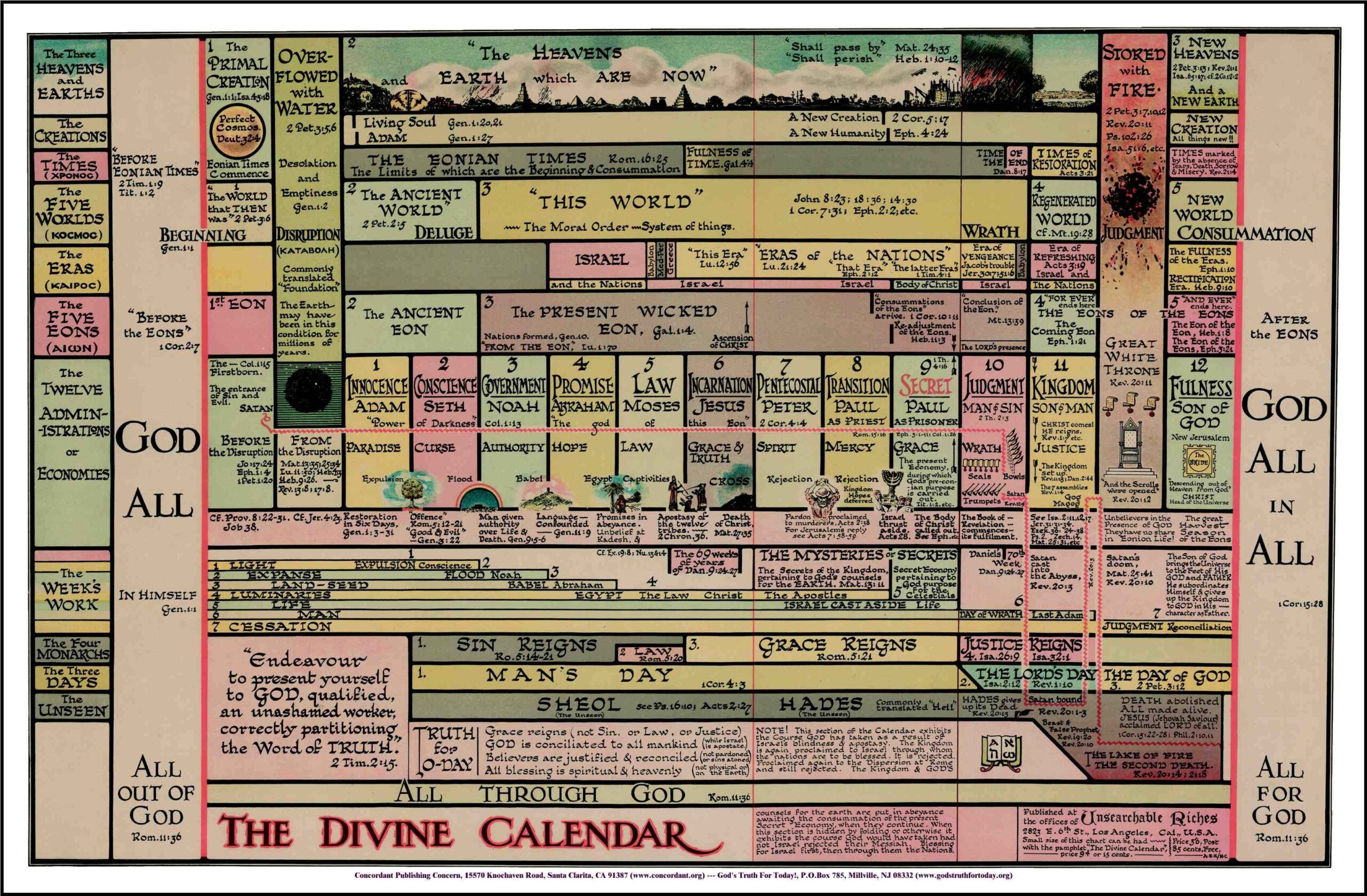
But even in passages where it might seem to make sense to interpret some of these terms literally at first glance, such as Romans 16:26 for example (which uses the phrase “the everlasting God” in the KJV), this still isn’t necessarily the case. Some would insist that to interpret it figuratively would mean that God will eventually die, but this verse isn’t actually trying to tell us that God’s life will never end in the first place. The fact of the matter is, we already know that God isn’t going to die based on earlier Scripture, such as Psalm 102:27, so that’s not something Paul needed to explain to his readers. Instead, if we interpret the word “everlasting” consistently with its other instances where it’s translated from αἰωνίων (meaning we interpret it as figuratively referring to a long period of time, or even as pertaining to the ages), we can see that Paul is likely just telling us that God is the age-pertaining God (or “the eonian God,” as the CLV renders the verse, with “eonian” being a transliteration of αἰωνίων used in the CLV that literally just means “pertaining to an eon/age, or to eons/ages”), meaning He doesn’t just sit on high, removed from our struggles in time, but rather that He cares about — and is even intimately involved in — what happens during the eons/ages. And those who might think this limits Him to the ages aren’t thinking things through carefully enough, since otherwise God being said to be the God of Abraham, Isaac, and Jacob would limit Him to being the God of those three men, and those three men alone, as well. And the same goes for passages such as Galatians 1:3-5 and Philippians 4:20, where a more consistent interpretation of the passages as figuratively saying “to our God and Father be glory for the ages of the ages” or “for the eons of the eons” (which is along the lines of how the YLT and the CLV translate them) wouldn’t mean they’re telling us that God’s glory will end when the ages do, any more than the figurative interpretation of Romans 16:26 means that God’s life would end at that time; it would just mean that Paul was simply focusing on the glory God will finally receive — which He certainly isn’t receiving during the current age, at least not to the extent He will at that time — when the two greatest ages finally begin (those two ages being known as “the ages of the ages,” or the “the eons of the eons,” depending on your Bible translation, which, as those who are familiar with the Doctrine of the Ages — more often referred to as the Doctrine of the Eons by “Concordant” believers — know, is referring to the thousand-year age, or eon, when the kingdom of heaven exists in Israel, as well as to the final age/eon on the New Earth, but I don’t have the space to get into the details of that topic here other than to include a chart called The Divine Calendar at the end of this article, although I should point out that it’s more based on the wording of the CLV than the KJV, but it will give you some idea of what I’m referring to; otherwise, though, I’m going to leave it up to you to dig deeper into that subject if you’re at all curious to learn more beyond that, and I highly recommend the book titled God’s Eonian Purpose by Adlai Loudy as a great starting point, which you can buy as a physical book, but which has also been made available by its publishers as a free PDF although keep in mind that Loudy made a distinction between “ages” and “eons” in his book which most others don’t, and he was also definitely not a KJV-Onlyist, but it’s still a very worthwhile read even if you are one). Simply put, with very few exceptions, the Bible doesn’t delve into details pertaining to the rest of eternity, but is instead focused almost entirely on details pertaining to the ages/eons (even though this fact might be less obvious to people who aren’t reading the more literal Bible translations, or who at least don’t consider the Bible’s original languages when studying it). What occurs after the end of the ages/eons isn’t something that God seems to want us to know about right now (other than to know that everyone will have been quickened/saved/made immortal by that time, as you’ll learn in a future article in this series), but rather He appears to want us to concern ourselves with what happens during the ages/eons instead.
However, even if we did interpret “everlasting” and “for ever and ever” in those particular passages as literally telling us that God is “never-ending,” the fact remains that “for ever” is still very often just figurative language that refers to “an age” or “ages,” or to “a seemingly long period of time with a definite beginning and end,” when it’s used in English in the KJV and other less literal Bible translations (not to mention in the original Hebrew and Koine Greek that these less literal Bible versions are translated from), as we’ve now learned, and the same goes for not only “everlasting,” but also “eternal,” which is often used as a synonym for “everlasting” in the KJV since it’s almost always translated from the same Greek word too — with the one exception in the KJV, where it’s instead translated from ἀΐδιος/“ah-id’-ee-os,” not causing any problem for the doctrine of the salvation of all humanity at all either. And so the bottom line is that we should always be considering the context of the passages these various words are being used in, as well as comparing these passages to the rest of Scripture, in order to determine whether these terms actually should be literally interpreted as meaning “without end” or “never-ending” (not to mention “can’t ever,” in the case of the word “never” being used) in those instances, or whether these English translations should be interpreted figuratively instead, to make sure a particular interpretation of these words in the KJV wouldn’t contradict other parts of the Bible, in other words. Because, just as the scriptural references to an “everlasting” Old Covenant (which — just like the Abrahamic Covenant that we also now know will eventually end — is referred to as an αἰωνίων covenant in the LXX) can’t literally be talking about a never-ending covenant, since that would contradict the passages which talk about how it has to fade away and be replaced with by a New Covenant, scriptural references to “everlasting” or “eternal” judgements (or even references to punishments which last “for ever,” or even “for ever and ever”) likewise can’t literally be talking about judgements and punishments which never actually end, since that would contradict the passages which talk about the salvation of all that we’re going to look at later in this series of articles.
This, by the way, also means that, while we can figuratively be said to be given “eternal life” at the point we believe the Gospel and are saved, this can really only be said to be the case from a relative, or perhaps proleptic, perspective at that time, because the actual, physical experience of “eternal life” — referring to our quickening and being taken to the heavens in the case of those of us in the body of Christ, and to getting to live in the kingdom of heaven during the thousand-year reign of Christ on earth in the case of those in the Israel of God — can’t really fully begin from a literal perspective until the final ages actually commence, since the phrase really means “age-pertaining life,” “life age-during,” or “eonian life” when interpreted consistently with the rest of the parts of Scripture that refer to salvation (and which is why the term is rendered along those lines in the more literal Bible translations), although it technically does begin a few years before the beginning of the final ages for the body of Christ, at least in a manner of speaking, but only by about seven years before at most.
And even if a KJV-Onlyist ignored everything I covered about the Hebrew and Greek words we just looked at, because they prefer to only consider the English words in the KJV, the facts about the figurative meaning of the English words they’re translated into in the KJV should still be pretty obvious based on the passages I used to discuss them in their original languages, and so it should now be clear to any King James Bible Believers who take the context of Scripture as a whole into consideration when interpreting the Bible and who have made it this far into the book that “everlasting,” “eternal,” and “for ever” (and even “never”) are rarely meant to be read literally in the King James Bible.
Of course, some Christians reading this will now be thinking that, if the “everlasting life” Jesus spoke about isn’t literally never-ending life, wouldn’t this mean we won’t actually have lives that never end? That isn’t the best conclusion to draw from this fact, however, since we don’t actually need verses about “everlasting life” to tell us we’ll eventually be in a state where we’ll never die to begin with, because it isn’t figurative verses about “everlasting life” (or “life eternal”) which promise us this anyway, but rather it’s verses about our impending immortality which teach us this fact (and not all Israelites will be made immortal at the time they experience “everlasting life,” as we’ve already covered in Part 1, but will have to wait until a future time for the quickening of their mortal bodies to occur, demonstrating quite clearly that “everlasting life” doesn’t literally mean life that can never end, even if they likely won’t ever die again since they’ll eventually be given immortality as well, although not until quite a long time after they begin their “everlasting life,” as you’ll learn a little later in this series). Of course, this all makes particular sense when we consider the fact that, even in less literal translations such as the KJV, Jesus Himself said that having “life eternal” simply figuratively means “that they might know thee the only true God, and Jesus Christ, whom thou hast sent,” which tells us that the term “life eternal” isn’t inherently referring to never dying anyway (at least for those He was ministering to during His time walking the earth). At the end of the day, though, while almost no Christian seems to consciously realize it, most of them are already interpreting “everlasting life” and “life eternal” in a qualitative, figurative manner rather than in a quantitative, literal manner, since, aside from believing what Jesus said “life eternal” means there, most of them also believe that all humans continue to live on without end after they die anyway, which means that being given “everlasting life” or “life eternal” isn’t required to have life that is literally, or quantitatively, everlasting or eternal (meaning a life that never ends), at least according to the theology of Christians who believe in the immortality of the soul, and hence “everlasting life” or “life eternal” can’t actually mean to never die, at least if they’re correct about the immortality of the soul. Think about it, if we’re already “eternal” beings, in the manner that most Christians believe we are, then “life eternal” or “everlasting life” can’t literally be talking about how long we continue to exist, since we’re all going to continue existing without end regardless of whether we have “life eternal” or not, according to the most common viewpoint. And so, most Christians already interpret terms like “life eternal” and “everlasting life” in a qualitative manner, and understand that they’re both actually simply a figure of speech connected with salvation rather than literally referring to how long one continues to exist (at least in the less literal Bible translations that use the terms), even if they hadn’t fully realized it until they read this. (And if “everlasting life” is a figurative term in these less-literal Bible translations, it makes sense to conclude that references to “everlasting punishment” must be figurative as well; and they indeed are, as I’ll prove a little later in this series too.) All that being said, those who die as believers don’t actually live “for ever” in an afterlife realm called heaven while they’re dead (although you’ll have to read the next article in this series to understand how I can say that), but the point still stands for those who assume they do.
Part 4: What is death?