As I wrote last week, many Infernalists (and, I should add, even some Annihilationists) will quote Bible verses assuming that they disprove Universalism, and presumably also somehow assuming that we’ve never heard those passages before (or at least assuming we don’t believe those passages are true).
Anyone who does that without already knowing how it is that we Biblical Universalists (especially we “Concordant” Universalists) interpret those passages has a big problem, however. As I mentioned in that article, we Biblical Universalists are not only already familiar with those passages, we actually agree with those passages 100% (just as we do all Scripture). It’s just that we don’t interpret them the same way that the Infernalists and/or Annihilationists do. This means that anyone who is simply quoting those passages to us assuming they refute Universalism is doing so without the knowledge of how we interpret those passages ourselves. And so they might be rejecting Universalism, but simply quoting the passages without also explaining how they can’t possibly mean what we Universalists believe they mean tells us they aren’t rejecting our interpretations of the passages at all, because doing so makes it evident that they don’t even know what our interpretations of those passages are in the first place (since, if they did, they’d also include why the passages can’t mean what we believe they mean), telling us they haven’t actually dug deep enough into Scripture to be able to legitimately reject Universalism at all yet.
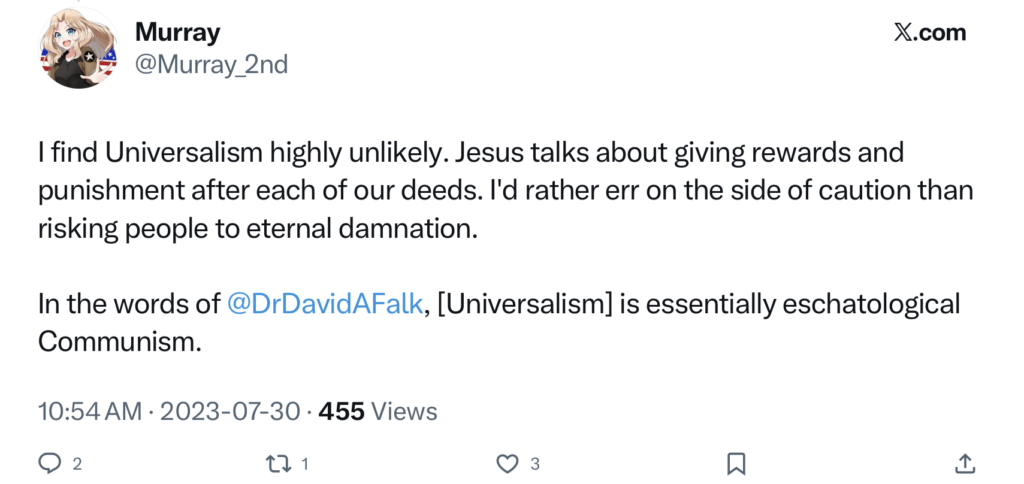
On a similar note, an Infernalist (or Annihilationist) who says things like what Murray said in the above tweet has also demonstrated that they haven’t actually studied the topic in depth enough to be ready to reject Universalism: “I find Universalism highly unlikely. Jesus talked about giving rewards and punishment after each of our deeds. I’d rather err on the side of caution rather than risking people to eternal damnation.” This is a statement that tells us the Infernalist in question wasn’t aware of the fact that we also believe in rewards and punishments for our deeds, and even in “eternal damnation,” which means they haven’t even begun to learn what it is one needs to know about soteriology, and, in fact, is at risk of experiencing the very “eternal damnation” they’re worried about themselves.
This is similar to the Infernalist who says things like, “But Jesus said few will be saved,” as though we aren’t aware of this fact already. No Biblical Universalist who believes and understands Scripture would ever claim that the statement Jesus made about few being saved is untrue, any more than we’d claim that some won’t suffer “eternal damnation.” It’s just that we know what these statements actually mean, and why they don’t contradict the fact that everyone will experience salvation in the end. In fact, some Infernalist is almost certainly reading this right now thinking that the idea of few being saved contradicts the idea of everyone being saved. This just means that aren’t familiar with the hermeneutics required to properly interpret Scripture, because this paradox is actually very easily resolved and isn’t a contradiction at all, as every Universalist can tell you.
So if you’re an Infernalist or Annihilationist who has read the above and doesn’t know how what I just wrote can be true, it means you haven’t studied the topic nearly enough to be able to legitimately reject Biblical Universalism yet, If you do want to know why we’re convinced that Biblical Universalism is what Scripture teaches, however, this free eBook is a good starting point: Biblical Universalism (Especially since literally every single Christian who disagreed with Biblical Universalism but read the whole book and got back to me said they couldn’t refute it and that they now agree with it too; and quite a few read it.)